
Mentoring again, on my own terms (@WomenGoTech)
09 Oct 2026It has been 4 years since I last mentored at WomenGoTech. I find the activity meaningful, yet it took me a while to sign up for a new cohort. It got me thinking - why is that?
Mentoring: how it is defined vs how I imagined it
With every mentoring opportunity (at WomenGoTech, at Vinted) we get an introductory course on what mentoring is and what we are supposed to do as mentors. Usually it focuses on things like active listening, asking open questions instead of leading ones and building a relationship.
But this leaves the technical part open to interpretation. The programme is about helping women get into tech, so surely there need to be some technical skills involved. How much of that is on me as a mentor and how should I approach it?
In the past, I used to stress about this a lot. I prepared presentations on technical topics and on what my work looks like. I even ran mock technical interviews. This made the mentoring period quite intense for me. Whenever a new opportunity presented itself, I would start to doubt whether I really had the time and energy for it.
How I wanted to approach it differently this time
Yet every time a new cohort was announced, I kept staring at the registration form. I would weigh the pros and cons over and over again. I took this as a signal that I still wanted to mentor. I decided to try again, but do it somehow differently. And that somehow was adding a note to my application that I would prefer to work on a coding project with my mentee.
I imagined that we would come up with a toy project together, do refinement sessions, prepare tasks in a free project board like Linear and then I could review pull requests. This would give the mentee practical coding experience and also shift the preparation work in between sessions onto them.
I also made a mental note to stress less about the 1:1 meetings. In the past I used to feel like I was short-changing the person if I didn’t have enough content for at least 45 minutes. This time I intended to let the meetings take a more natural flow.
The actual mentee and coding project
Adding the project note to my application turned out to be a great idea. WomenGoTech matched me with a person who already had a coding project in mind. And not just a toy project, but a real one, in a domain that I really care about.
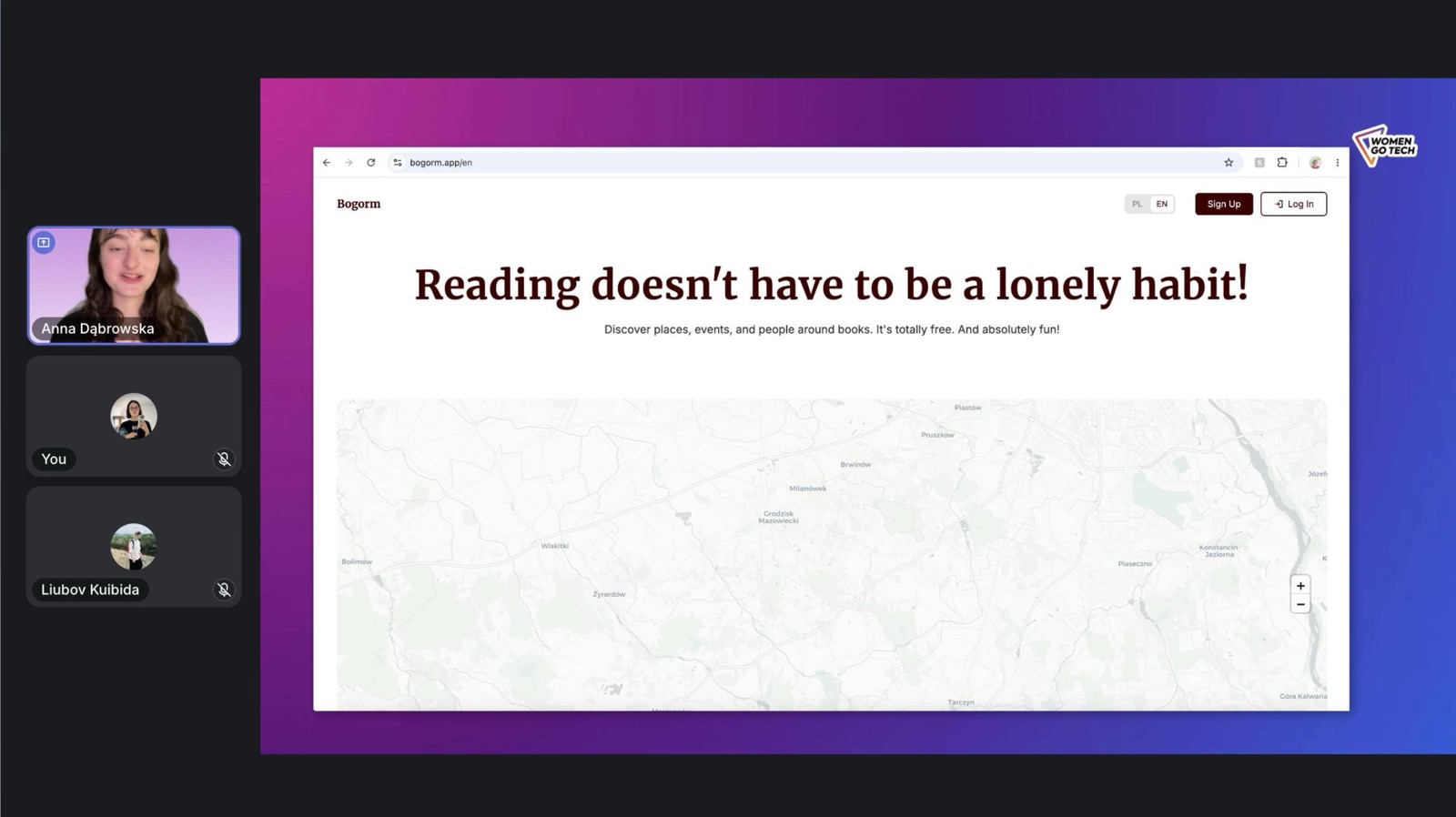
The project is Bogorm (Danish for bookworm) - an interactive map of various reading events and places. It is meant to remind us that reading does not have to be a lonely experience. It resonates with me, as reading is one of my favourite leisure activities. For a while I even used to post book reviews to Goodreads and Instagram.
The author is Liuba Kuibida. She already had experience as a frontend developer, but wanted to build the backend for the app herself, and this is where I came in.
I don’t think this match was a coincidence. It seems the organisers really do read the application notes. If you are thinking about applying as a mentor, take a moment to consider what you expect from the mentorship and how you like to work. Then mention it in your application.
How we approached the mentorship
Liuba had been both a mentee and a mentor before. She brought a lot of structure to our interactions, including SMART goals with a timeline set up in Notion. We agreed to meet every two weeks. During these calls, we discussed what was already done and what could be an appropriate goal for the next check-in. This format was very similar to what all the mentoring workshops talked about - I listened actively and, where it made sense, shared observations and advice from my own experience. In between the calls, she would do the coding and I would review pull requests.
As for the 1:1s, the mental note helped. They weren’t completely stress-free, but they were definitely calmer than before. We didn’t have a fixed agenda and I didn’t prepare anything in advance. Liuba would share her progress and ask questions, and the conversation would go from there. Some calls were short, and in others we drifted off to chat about unrelated things. I didn’t feel I had to fill 45 minutes with content anymore, and I could actually enjoy our conversations.
This was much lighter than my previous mentoring experiences, and it still felt useful. It turns out the thing holding me back was my own definition of mentoring.
Reviewing pull requests in a stack I don’t know
Liuba was already familiar with Python and Django, so we agreed they were the best choice for the backend. I, however, have almost no experience with either. I did plan to learn them for the project with my husband, but it never went further than a plan. Luckily, in the age of AI this wasn’t a big problem. I have a Claude Code subscription for my personal needs. I would run /code-review on the project, browse the output and look for things I could turn into a general lesson on backend engineering, e.g.:
- having different configurations for testing and production environments
- using libraries like factory_boy to generate test data in the most readable way
- having the correct separation of responsibilities between models and views (Django’s version of controllers)
For lessons like these, I added links to the documentation or other resources to my comments, so Liuba could read up on the topic herself.
Of course, reviewing code in a framework I don’t know had its risks. AI can be confidently wrong or miss the context of the project, so I was picky about what I passed on. I mostly focused on issues I recognised from general backend engineering. When the AI flagged something and I couldn’t see why it was a problem, I dug deeper and asked for links to the documentation. Sometimes I also turned things around and asked my own questions, for example whether the project’s split into Django apps followed the framework’s conventions.
Sharing my AI skills
The mentorship lasts 6 months, but the project needs more time to finish. During the second half of our collaboration, I wanted to guide Liuba towards doing the AI reviews on her own. I shared my process with Claude Code, plus a new review skill I had recently started using - /ponytail-review. It complements /code-review nicely, as it focuses on code that can be removed, like duplication or things the framework already provides. This helps keep the code clean and DRY, and cuts down on AI slop when some of the code is AI-generated. Liuba picked up the approach quickly and now runs these reviews on her own.
Closing the programme
The programme closed with a virtual event, where Anna Dabrowska shared some statistics about WomenGoTech in general, the current cohort and things to come. Liuba and I also got a chance to present the project and reflect on our experience. My part was a short version of this post, and preparing it is what made me want to write the full story down.
The programme may be over, but our check-ins aren’t. We plan to keep them going at least until the end of November, when Liuba reaches the next milestone she has planned for the app. It no longer feels like something I signed up for, but like something I’d miss if it stopped.
My biggest takeaway from the programme
When programmes like WomenGoTech look for mentors, they usually advertise benefits such as new connections and the chance to learn by explaining things to others. What I got was something different, and I don’t think it gets mentioned nearly enough: motivation. For 6 months I watched Liuba make steady progress, like deploying to production for the first time and seeing the app live. It pushed me to get back to my own projects: reading technical books, writing this blog and working on the book-related app with my husband. I have been more consistent with them than I have in years. Our check-ins were a regular reminder that a couple of hours a week is all it takes to keep moving forward.
I don’t think I would have felt this way during my earlier cohorts. Back then, I had set the bar for being a good mentor so high that mentoring stressed me out, and as a result drained my energy. That is why it took me 4 years to return. Once I lowered the bar, mentoring started giving energy back instead.